 ## Model Overview
- Type: autoregressive language model
- Training stage: pre-training
- Language model
- Number of parameters: 80B total, 3B activated
- Hidden size: 2048
- Vocabulary size: 129024
- Number of layers: 48
- Layer layout: 12 × (3 × (KDA → MoE) → 1 × (Gated Attention → MoE))
- KDA:
- Number of query heads: 32
- Number of KV heads: 32
- Query head dimension: 128
- KV head dimension: 128
- Convolution kernel size: 4
- Gated Attention:
- Number of query heads: 16
- Number of KV heads: 2
- Query head dimension: 256
- MoE:
- Number of experts: 512
- Top-K: 10 routed + 1 shared expert
- Expert intermediate size: 512
- MTP: 1 layer
- Context length: 262144
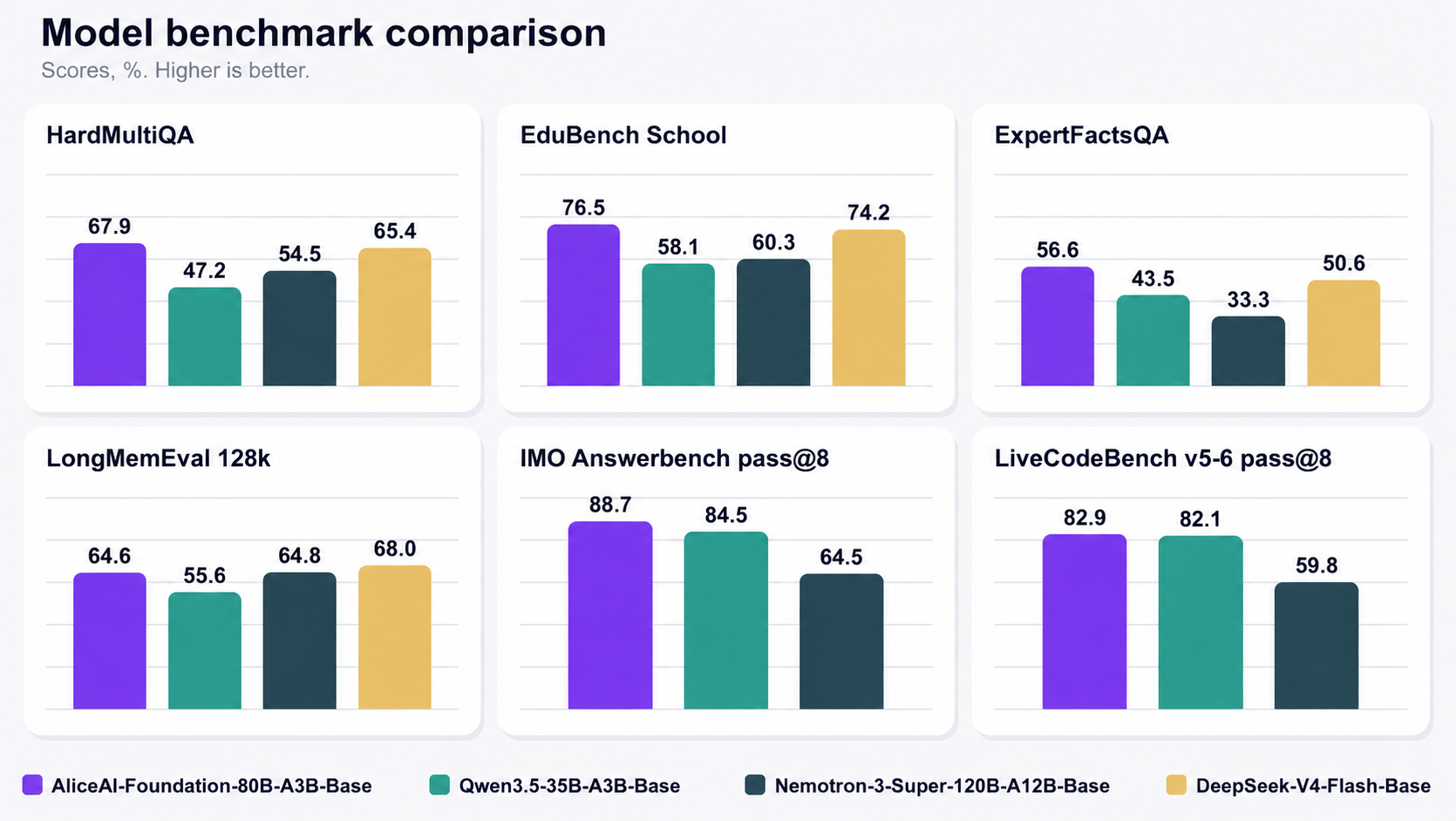
## Benchmarks
## Model Overview
- Type: autoregressive language model
- Training stage: pre-training
- Language model
- Number of parameters: 80B total, 3B activated
- Hidden size: 2048
- Vocabulary size: 129024
- Number of layers: 48
- Layer layout: 12 × (3 × (KDA → MoE) → 1 × (Gated Attention → MoE))
- KDA:
- Number of query heads: 32
- Number of KV heads: 32
- Query head dimension: 128
- KV head dimension: 128
- Convolution kernel size: 4
- Gated Attention:
- Number of query heads: 16
- Number of KV heads: 2
- Query head dimension: 256
- MoE:
- Number of experts: 512
- Top-K: 10 routed + 1 shared expert
- Expert intermediate size: 512
- MTP: 1 layer
- Context length: 262144
## Benchmarks
Russian-language benchmark names are shown in green; English-language benchmark names are shown in blue.
All results in this section were obtained using our internal evaluation infrastructure, with inference performed in vLLM at t=0 for every model. The best result in each row is shown in bold.
| Benchmark | AliceAI-Foundation-80B-A3B-Base | Qwen3.5-35B-A3B-Base | GLM-4.5-Air-Base (106B-A12B) | Nemotron-3-Super-120B-A12B-Base | DeepSeek-V4-Flash-Base (284B-A13B) |
|---|---|---|---|---|---|
| Facts | |||||
WikiWebFacts5-shot benchmark of factual knowledge in Russian. | 86.5 | 62.4 | 70.2 | 72.8 | 83.2 |
HardMultiQA5-shot benchmark of factual knowledge in Russian. | 67.9 | 47.2 | 48.6 | 54.5 | 65.4 |
CultCat4-shot benchmark of cultural knowledge. Read more in our article on Habr. | 86.5 | 59.2 | 59.1 | 66.3 | 80.7 |
TriviaQA5-shot open benchmark of factual knowledge in English; LLM-as-a-judge is used instead of Exact Match. | 79.0 | 71.4 | 83.5 | 89.8 | 89.4 |
| Educational benchmarks | |||||
EduBench Russian5-shot education benchmark built from queries submitted to Alice. | 74.2 | 42.9 | 39.0 | 44.0 | 67.7 |
EduBench Literature5-shot education benchmark built from queries submitted to Alice. | 73.8 | 51.8 | 51.4 | 55.8 | 69.1 |
EduBench History5-shot education benchmark built from queries submitted to Alice. | 82.0 | 65.9 | 62.8 | 70.2 | 76.9 |
EduBench English5-shot education benchmark built from queries submitted to Alice. | 76.1 | 71.7 | 67.2 | 71.3 | 82.9 |
| Expert knowledge | |||||
ExpertFactsQA Medicine5-shot factual-knowledge benchmark created by domain experts. | 63.6 | 59.0 | 50.6 | 42.3 | 60.7 |
ExpertFactsQA LawChallenging 5-shot factual-knowledge benchmark created by domain experts. | 49.6 | 27.9 | 22.5 | 24.3 | 40.5 |
| Exams | |||||
EGE CoT5-shot benchmark based on multiple-choice Unified State Exam tasks across various subjects. | 90.5 | 84.7 | 77.8 | 84.3 | 90.3 |
MMLU-Pro CoT5-shot open benchmark of knowledge and reasoning across a broad range of subjects in English. | 66.8 | 63.2 | 58.4 | 69.9 | 66.5 |
SuperGPQA CoT5-shot open benchmark containing questions written by experts from different scientific fields. | 44.3 | 43.6 | 35.4 | 46.6 | 46.1 |
| Mathematics | |||||
MATH-5005-shot benchmark of mathematical problems; it uses LLM-as-a-judge and longer reasoning traces in the few-shot examples. | 91.1 | 81.9 | 60.2 | 84.8 | 80.7 |
EduBench Math5-shot education benchmark built from queries submitted to Alice | 79.3 | 80.0 | 56.9 | 69.7 | 76.3 |
EduBench Math University5-shot education benchmark built from queries submitted to Alice. | 70.1 | 69.9 | 51.4 | 67.4 | 68.6 |
| Coding | |||||
BigCodeBench 1-shot pass@11-shot, our implementation of BigCodeBench with improved tests. | 48.3 | 43.5 | 44.5 | 48.8 | 49.1 |
LiveCodeBench v5-6 CoT 1-shot pass@11-shot open benchmark of challenging programming problems that require finding an algorithm and implementing it in code. | 50.5 | 50.4 | 22.6 | 50.4 | 38.1 |
| Long context | |||||
FinQA 128k5-shot long-context adaptation of the open-source FinQA benchmark, featuring financial-report analysis tasks. | 74.1 | 73.5 | 35.5 | 71.7 | 74.1 |
LongMemEval 128k5-shot open benchmark of finding and using information from long dialogue histories. | 64.6 | 55.6 | 50.6 | 64.8 | 68.0 |
All results in this section were obtained using our internal evaluation infrastructure, with inference performed in vLLM at t=1 and repetition penalties (repetition_penalty=1, presence_penalty=1.5) for every model. The best result in each row is shown in bold.
| Benchmark | AliceAI-Foundation-80B-A3B-Base | Qwen3.5-35B-A3B-Base | Nemotron-3-Super-120B-A12B-Base |
|---|---|---|---|
| Complex reasoning | |||
AIME 2026 pass@320-shot problems from the American Invitational Mathematics Examination. | 96.7 | 96.7 | 90.0 |
HMMT 2026 Feb pass@320-shot problems from the February Harvard–MIT Mathematics Tournament. | 96.9 | 87.9 | 66.7 |
IMO Answerbench pass@80-shot problems from the International Mathematical Olympiad. | 88.7 | 84.5 | 64.5 |
CodeForces CPP pass@80-shot competitive-programming problems from Codeforces in C++. | 68.9 | 73.7 | 56.6 |
LiveCodeBench v5-6 pass@10-shot open benchmark of challenging programming problems. | 60.4 | 51.9 | 34.7 |
LiveCodeBench v5-6 pass@80-shot open benchmark of challenging programming problems. | 82.9 | 82.1 | 59.8 |