--- base_model: Qwen/Qwen3.8-Flash-Next base_model_relation: quantized pipeline_tag: image-text-to-text library_name: gguf license: apache-2.0 tags: - gguf - gsq - rco - quantization - mixed-precision - ist-daslab - moe - multimodal - vision ---
GGUF, GSQ-RCO dynamic non-uniform quantization
# Qwen3.8-Flash-Next · GSQ-RCO GGUFs **Non-uniform GGUF quantizations** of a 512-expert MoE, produced with **GSQ** and **RCO**, with a vision projector for multimodal use. [![arXiv: GSQ](https://img.shields.io/badge/arXiv-GSQ_2604.18556-b31b1b?logo=arxiv&logoColor=white)](https://arxiv.org/abs/2604.18556) [![arXiv: RCO](https://img.shields.io/badge/arXiv-RCO_2605.00649-b31b1b?logo=arxiv&logoColor=white)](https://arxiv.org/abs/2605.00649) [![GSQ code](https://img.shields.io/badge/code-GSQ-181717?logo=github&logoColor=white)](https://github.com/IST-DASLab/GSQ) [![RCO code](https://img.shields.io/badge/code-RCO-181717?logo=github&logoColor=white)](https://github.com/IST-DASLab/RCO) [![DASLab](https://img.shields.io/badge/DASLab-GitHub-101048?logo=github&logoColor=white)](https://github.com/IST-DASLab) [![license](https://img.shields.io/badge/license-apache--2.0-19a34a)](#license)

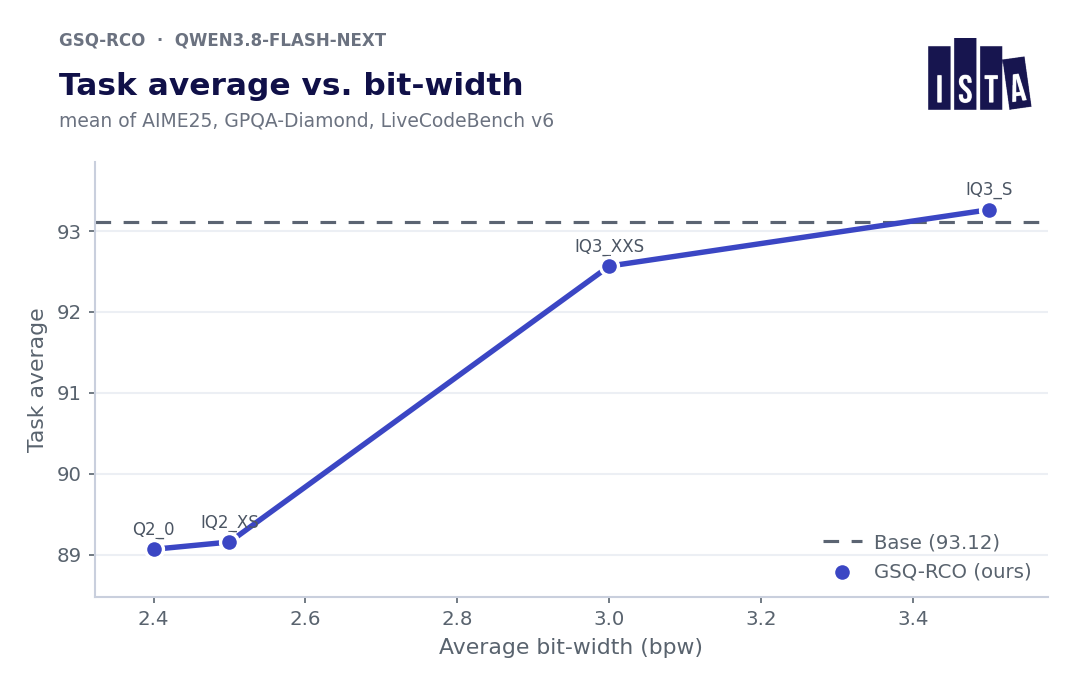
![Task average vs bit-width](assets/plots/Qwen3.8-Flash-Next-task_avg_vs_avg_bit_width.png) --- ## Overview This repository provides GGUF quantizations of **Qwen3.8-Flash-Next** at four sizes, together with the model's vision projector (`mmproj`) for multimodal use. In contrast to uniform quantization, which applies a single quantization type to all weight tensors, each model here assigns a separate quantization type to every tensor. The assignment is obtained by a gradient-based search that allocates precision according to per-tensor sensitivity, subject to a total size budget. The resulting files are standard GGUF and run unmodified in `llama.cpp`, Ollama, and LM Studio. A code-specialized variant is released separately as [Qwen3.8-Flash-Next-GSQ-RCO-Coder](https://huggingface.co/ISTA-DASLab/Qwen3.8-Flash-Next-GSQ-RCO-Coder-GGUF), which retains 256 of the 512 routed experts per layer at an effective 1.89 bpw over the original parameters, for a 58.4 GB total. Flash-Next is a sparse mixture-of-experts model: **512 routed experts per layer across 48 layers**, of which 10 are active per token. The routed expert matrices dominate the parameter count, so they also dominate the size budget: 95% of the searchable weights live in the experts. The search therefore spends most of its freedom there, assigning a quantization type **per layer** (not per expert, which GGUF cannot express). > **Method summary.** GSQ provides accurate low-bit scalar quantization of each tensor at a given quantization type; RCO assigns the per-tensor quantization types under a size budget. Together they yield a non-uniform GGUF at the requested size. | Method | Description | |---|---| | **GSQ** (Gumbel-Softmax Quantization, [paper](https://arxiv.org/abs/2604.18556), [code](https://github.com/IST-DASLab/GSQ)) | Post-training scalar quantization that jointly learns the per-coordinate grid assignments and the per-group scales via a Gumbel-Softmax relaxation. GSQ closes most of the gap between scalar and vector quantization at 2 to 3 bits while remaining deployable in standard scalar formats such as GGUF. | | **RCO** (Riemannian Constrained Optimization, [paper](https://arxiv.org/abs/2605.00649), [code](https://github.com/IST-DASLab/RCO)) | Assigns one of K quantization types to each of N tensors under a total size budget. The budget constraint is reformulated as a smooth Riemannian manifold in logit space, which permits gradient-based optimization directly on the task loss while enforcing the budget exactly, without constraint-specific hyperparameter tuning. | Both methods were developed at the [Deep Algorithms and Systems Lab (DASLab)](https://github.com/IST-DASLab), Institute of Science and Technology Austria. --- ## Available files Files follow the convention **`-GSQ-RCO-.gguf`**, where the suffix names the quantization class; the table lists each file's average bit-width over the transformer weights. The `mmproj` file carries the vision encoder and projector at BF16; one copy serves all quantizations. Each quantized model ships as **two shards**. The second shard is identical across all four variants: it holds the per-layer n-gram embedding table (`per_layer_token_embd`, 51.2B parameters) at IQ4_NL. That table is a lookup, not a matmul weight, so it is held at a fixed 4.5 bpw in every build and excluded from the search. It is quantized in the evaluated models, not just the shipped ones. | Directory | bpw | Shard 1 (weights) | Shard 2 (n-gram) | Total | Notes | |---|---|---|---|---|---| | `Q2_0/` | 2.40 | 37.6 GB | 28.8 GB | **66.4 GB** | Fastest; avoids lookup-table formats | | `IQ2_XS/` | 2.50 | 39.2 GB | 28.8 GB | **68.0 GB** | Smallest at equal quality | | `IQ3_XXS/` | 3.00 | 47.0 GB | 28.8 GB | **75.8 GB** | Matches the base model on AIME25 | | `IQ3_S/` | 3.50 | 54.8 GB | 28.8 GB | **83.6 GB** | Recommended; matches or exceeds the base model on every task | | `mmproj-Qwen3.8-Flash-Next-BF16.gguf` | 16 | 0.91 GB | n/a | **0.91 GB** | Vision encoder + projector, for multimodal use | **Q2_0** is built for speed. It avoids the quantization formats that rely on large lookup tables: those formats pack more accuracy into a given bit-width, but decoding them costs real time, and on this model that cost dominates inference. Q2_0 delivers **3.4x the prompt throughput** and **1.9x lower end-to-end latency** than IQ2_XS at a slightly smaller file size, and its decode rate stays flat across workloads instead of varying with the content. The trade is a little quality: 89.07 task average against 89.16 for IQ2_XS, and 3.5 points below IQ3_XXS. Pick it when throughput matters most, and see [Performance](#performance) for the measurements. The IQ3_S model is the strongest operating point: it matches the base model exactly on AIME25 (100.00), exceeds it on GPQA-Diamond (92.93 against 91.92) and is within 0.57 points on LiveCodeBench v6, at under a quarter of the BF16 size. IQ3_XXS remains the better choice when memory is tight: it gives up 1.52 points on GPQA-Diamond and 0.57 on LiveCodeBench v6 for 7.8 GB less. ### Memory requirements Only the first shard holds transformer weights and needs to be resident. The second shard is the n-gram lookup table: it is read sparsely, one row per token, so it can stay memory-mapped on disk and does not need to occupy VRAM. Run with `-lm mmap --lazy-mode on` to get this behaviour, plan for **shard 1 in VRAM**, and keep shard 2 on an SSD so the paging stays cheap. | Model | Must be resident (shard 1) | Can stay on disk (shard 2) | Total download | |---|---|---|---| | `Q2_0` | 37.6 GB | 28.8 GB | 66.4 GB | | `IQ2_XS` | 39.2 GB | 28.8 GB | 68.0 GB | | `IQ3_XXS` | 47.0 GB | 28.8 GB | 75.8 GB | | `IQ3_S` | 54.8 GB | 28.8 GB | 83.6 GB | Add headroom for the KV cache and the vision projector (0.91 GB) if used. Keeping the n-gram table in RAM rather than on disk removes the paging cost entirely and is worth it where memory allows. --- ## Performance Measured with `llama.cpp` over 55 prompts spanning eleven categories (coding, humanities, math, QA, RAG, reasoning, STEM, writing, multilingual, summarization, roleplay). | Model | Prompt t/s | Decode t/s | Avg latency | |---|---|---|---| | `Q2_0` | **367.49** | **93.79** | **6.70 s** | | `IQ2_XS` | 108.19 | 70.30 | 12.68 s | ![Prefill throughput by category](assets/plots/Qwen3.8-Flash-Next-prefill_throughput.png) The gap comes from the quantization formats rather than the size: the two files differ by only 1.6 GB, and Q2_0 is the smaller of the two. Q2_0's decode rate is also far more stable across categories, 92.5 to 94.5 t/s (a 2.0 t/s spread), where IQ2_XS swings from 49.4 to 94.5 t/s (a 45.1 t/s spread), because the lookup cost varies with how much of each layer a request touches. The prefill advantage is uneven, and largest where prompts are long: 9.6x on RAG, 6.8x on writing and 6.2x on coding. On short-prompt, reasoning-heavy categories the two are level or Q2_0 is marginally behind (0.8x to 0.9x on stem, math and reasoning), where prefill is too brief for the format's decoding cost to matter. --- ## Results All models are evaluated against the **BF16** base model. We report the average over five zero-shot tasks (arc_easy, arc_challenge, hellaswag, winogrande, piqa), recovery (zero-shot average relative to BF16), and three reasoning and generation benchmarks: **AIME25**, **GPQA-Diamond**, and **LiveCodeBench v6**. Task average is the mean of the three. Sizes are the full download, including the n-gram shard; the bit-width column is the average over the transformer weights, which is what the search controls. | Variant | bpw | GB | ZS avg↑ | recovery | AIME25↑ | GPQA-D↑ | LCB v6↑ | Task avg↑ | |---|---|---|---|---|---|---|---|---| | BF16 | 16.00 | 354 | 76.94 | 100.0% | 100.00 | 91.92 | 87.43 | 93.12 | | **GSQ-RCO Q2_0** | 2.40 | 66.4 | **78.00** | **101.4%** | 96.67 | 89.39 | 81.14 | 89.07 | | **GSQ-RCO IQ2_XS** | 2.50 | 68.0 | 77.16 | 100.3% | 96.67 | 87.37 | 83.43 | 89.16 | | **GSQ-RCO IQ3_XXS** | 3.00 | 75.8 | 77.23 | 100.4% | **100.00** | 91.41 | 86.29 | 92.57 | | **GSQ-RCO IQ3_S** | 3.50 | 83.6 | n/a | n/a | **100.00** | **92.93** | **86.86** | **93.26** | All three models exceed the BF16 base on the zero-shot average (100.3% to 101.4%), which is common for careful low-bit quantization on these five tasks: the differences are within roughly one standard error and should be read as parity rather than improvement. The same applies where IQ3_S exceeds the base on GPQA-Diamond and on the task average: recoveries slightly above 100% reflect benchmark variance, not a model that is better than the one it was quantized from. The reasoning and generation benchmarks separate the models far more clearly. At 3.00 bpw, IQ3_XXS reaches **99.4%** of the base model's task average (92.57 against 93.12) while being **4.7x smaller** (75.8 GB against 354 GB). It matches the base exactly on AIME25 (100.00), and trails by 0.51 on GPQA-Diamond and 1.14 on LiveCodeBench v6. At 2.50 bpw, IQ2_XS retains 95.7% of the task average at 68.0 GB, and the smallest build, Q2_0, holds 96.67 on AIME25 at 66.4 GB, a 5.3x reduction. The two sub-2.5 bpw builds land within 0.1 points of each other on task average despite different allocations: Q2_0 is stronger on GPQA-Diamond (89.39 against 87.37) while IQ2_XS is stronger on LiveCodeBench v6 (83.43 against 81.14). ![AIME25 vs bit-width](assets/plots/Qwen3.8-Flash-Next-aime25_vs_avg_bit_width.png) ![GPQA-Diamond vs bit-width](assets/plots/Qwen3.8-Flash-Next-gpqa_diamond_vs_avg_bit_width.png) ![LiveCodeBench v6 vs bit-width](assets/plots/Qwen3.8-Flash-Next-lcb_vs_avg_bit_width.png) --- ## Usage Both shards must be downloaded; `llama.cpp` loads the split automatically when given the first one. ### llama.cpp ```bash # download (requires: pip install -U "huggingface_hub[cli]") hf download --include "IQ3_XXS/*" --local-dir . llama-cli -m IQ3_XXS/Qwen3.8-Flash-Next-GSQ-RCO-IQ3_XXS-00001-of-00002.gguf \ -lm mmap --lazy-mode on \ -p "Explain mixed-precision quantization." -ngl 99 ``` `-lm mmap --lazy-mode on` keeps the n-gram table memory-mapped on disk instead of loading it into memory, which removes 28.8 GB from the resident footprint. See [Memory requirements](#memory-requirements). ### Strata Engine Many users report strong results with [Strata](https://github.com/Niko1221/Strata), a third-party engine that runs these GGUFs on a single NVIDIA GPU from 8 GB of VRAM, with a one-click installer and an OpenAI-compatible endpoint on localhost. ### Vision (multimodal) ```bash hf download mmproj-Qwen3.8-Flash-Next-BF16.gguf --local-dir . llama-mtmd-cli -m IQ3_XXS/Qwen3.8-Flash-Next-GSQ-RCO-IQ3_XXS-00001-of-00002.gguf \ --mmproj mmproj-Qwen3.8-Flash-Next-BF16.gguf \ -lm mmap --lazy-mode on \ --image photo.jpg -p "Describe this image." ``` The projector was converted directly from the base checkpoint and is shared by all four quantizations. ### Ollama ```bash ollama run hf.co/ # pick the directory matching your memory budget ``` ### LM Studio Search the repo name, then pick a `GSQ-RCO-*` build from the file list. --- ## Quantization procedure 1. **Per-tensor database.** Each weight tensor is quantized at every candidate GGUF quantization type with GSQ, yielding a searchable database of quantized tensor variants. 2. **RCO search.** The budget-constrained Riemannian search assigns one quantization type per tensor such that the whole-file average bit-width meets the target. 3. **Assembly.** The selected per-tensor variants are stitched into a single standard GGUF file. For this model the search covers **352 tensors**: the 304 dense tensors (attention, SSM projections, shared experts, embeddings, output head) and the 48 fused routed-expert matrices, one per layer. Two classes draw on separate quantization ladders, because the routed experts sit at a much lower bit-width than the dense path at any given budget. `ffn_down_exps` searches over a much smaller ladder than the other expert matrices. Its 640 rows are not divisible by 256, which rules out every block-256 K and I quant format and leaves only Q2_0 (block 64) and IQ4_NL (block 32). In the two smaller builds every layer lands on Q2_0; in IQ3_XXS the search lifts 18 of the 48 layers to IQ4_NL. Reference implementations: **GSQ** at [IST-DASLab/GSQ](https://github.com/IST-DASLab/GSQ) and **RCO** at [IST-DASLab/RCO](https://github.com/IST-DASLab/RCO). ### Reproducibility artifacts Each released GGUF ships the files needed to audit how it was built: | File | Contents | |---|---| | `tensor-allocation/.rco-allocation.txt` | The quantization type assigned to every tensor in that file, with a quant-type histogram and the target bit-width. This is the RCO search result, so the allocation can be inspected without opening the model. | --- ## Citation If you use these models or methods, please cite both papers: ```bibtex @article{gsq2026, title = {GSQ: Highly-Accurate Low-Precision Scalar Quantization for LLMs via Gumbel-Softmax Sampling}, author = {Dadgarnia, Alireza and Tabesh, Soroush and Nikdan, Mahdi and Helcig, Michael and Kurtic, Eldar and Kleinegger, Maximilian and Alistarh, Dan}, journal= {arXiv preprint arXiv:2604.18556}, year = {2026} } @article{rco2026, title = {Model Compression with Exact Budget Constraints via Riemannian Manifolds}, author = {Helcig, Michael and Alistarh, Dan}, journal= {arXiv preprint arXiv:2605.00649}, year = {2026} } ``` --- ## Acknowledgements We thank [Verda](https://verda.com/) and Scientific Computing at the Institute of Science and Technology Austria for providing the compute resources used to produce these models. --- ## License These quantized weights inherit the license of the base model (**Qwen3.8-Flash-Next**). The GSQ-RCO tooling is released by the Deep Algorithms and Systems Lab under its repository license.
Built with GSQ and RCO at the Deep Algorithms and Systems Lab · Institute of Science and Technology Austria